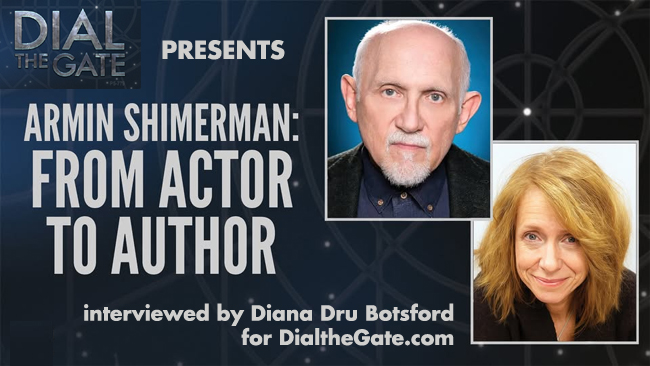
The beloved Star Trek and Stargate actor opens up about his evolution from embodying characters to creating them.
What happens when a beloved character actor decides his tombstone shouldn’t simply read “Quark”? For Armin Shimerman—known to millions as the scheming but lovable Ferengi bartender on Star Trek: Deep Space Nine and to Stargate fans as Anteaus of the Nox in the classic Season 2 episode written by Hart Hanson (who would later create Bones)—the answer was picking up a pen instead of a script.
I recently had the privilege of sitting down with Armin for Dial the Gate, David Read’s wonderful Stargate oral history podcast, to explore his fascinating journey from actor to author. What emerged was a deeply thoughtful conversation about craft, legacy, and what it means to be a storyteller in multiple mediums. Armin revealed that writing wasn’t actually a second act—it was his first love. As a young man, he dreamed of being a writer before acting claimed his attention, even winning awards for his verse at thirteen. It was during the long hours between takes on Deep Space Nine that he returned to that original passion, turning off the TV in his trailer and opening his laptop instead.
 The conversation covered everything from his collaborative experience writing The 34th Rule (the DS9 novel he developed with David George) to his alternate history trilogy Illyria, which draws on his lifelong scholarship in Shakespearean studies. Armin’s description of writing as “lonely, isolated, and when you’re done, enormously thrilling” captures the essential paradox every author knows. As someone who has spent a career bouncing off scene partners, he found himself having to be every character in the conversation—a challenge he met by drawing on decades of experience visualizing how people react and respond. One reviewer noted that Armin writes in a way that puts you in the scene so completely you can almost hear the sounds being described, and our conversation explored how his actor’s instincts inform that immersive quality.
Perhaps most moving was Armin’s reflection on legacy. He spoke candidly about wanting to leave something beyond his iconic television roles—something he created rather than interpreted. His discussion of the famous Deep Space Nine episode “Far Beyond the Stars,” where the cast portrayed 1950s science fiction writers, was particularly poignant. It remains the cast’s favorite episode, he explained, not because they got out of makeup, but because it pulled back the curtain to honor the writers as the true heroes of their storytelling enterprise. For those of us who write in the science fiction universe—whether for Stargate, Star Trek, or original worlds—it was a beautiful validation of our craft from someone who has seen storytelling from every angle.
I hope you’ll watch the full interview. Whether you’re a Stargate fan who remembers the gentle wisdom of the Nox, a Trekkie who grew up with Quark’s Rules of Acquisition, or simply someone interested in what drives creative people to keep reaching for new forms of expression, there’s something here for you. And for my fellow writers, Armin’s insights on the business of publishing, the challenge of selling your first book, and the pure joy of seeing your work on a bookstore shelf offer both inspiration and practical wisdom.
About the Interview: This conversation was recorded as Episode 362 of Dial the Gate, the Stargate oral history project hosted by David Read. Diana Botsford is the author of the Stargate SG-1 novels Four Dragons and The Drift, co-writer of the Star Trek: The Next Generation episode “Rascals,” and a writing instructor with nearly two decades of experience in university screenwriting education.