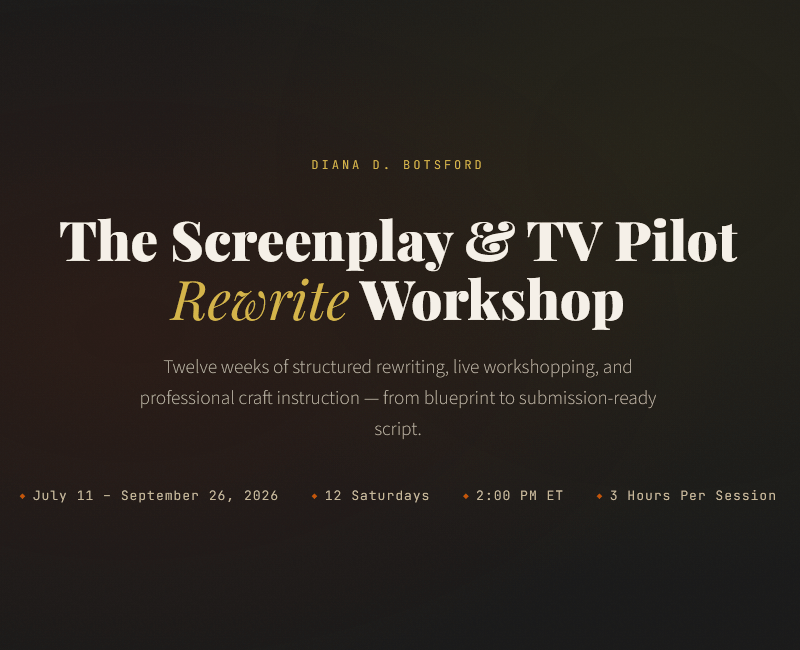
You finished your first draft. Now make it exceptional.
Most writers attack a rewrite by starting on page one and tweaking forward. It’s like chipping away at interior beams without looking at the blueprint first. Before long you’re in a cloud of sheetrock dust — and you may have just knocked out a load-bearing wall. This workshop gives you the blueprint. Over twelve weeks, you’ll move through a proven six-phase rewriting process — from structural diagnosis through line-level polish — with live feedback every Saturday, a dedicated critique partner on the same journey, and guided video lectures on the craft of revision. You’ll leave with a stronger script, the skills to keep refining it, and the marketing materials to get it into the right hands.
Writing IS rewriting.
Even Hemingway took 55 drafts to perfect each of his manuscripts. One full pass through your script is just the beginning. It’s time to do more.
Who This Is For
Writers with a draft and the drive to make it better
Screenplay WritersYou have a feature-length first draft (90–150 pages) that needs structural work, character deepening, or a full revision pass. The 12-week workshop gives you the runway to rewrite your script sequence by sequence with professional feedback at every stage. |
TV Pilot WritersYou have a pilot draft (30–70 pages) ready for rewriting. The workshop’s pacing means you’ll likely complete your first full rewrite pass with weeks to spare — giving you the opportunity to begin a targeted second pass on a specific craft element like dialogue, character arcs, or the 10% cut. |
Series CreatorsYou have a pilot and series concept that need to work in tandem. The workshop addresses both the episode-level story and the series-level promise your pilot is making — because a pilot script isn’t just an episode, it’s a pitch for an entire show. |
Writers Returning to a Shelved ScriptYou wrote a draft months or years ago, stepped away, and now you’re ready to come back to it with fresh eyes and a real plan. The structured approach will help you see the script clearly again and know exactly where to begin. |
The Method
Six phases. One focused pass at a time.
The most common rewriting mistake is tackling everything at once — fixing dialogue while restructuring plot while trying to deepen character. The result is writing in circles. This workshop moves you through six targeted phases, from the biggest structural questions down to the finest line-level details.
| Phase 1 — Assess Your Draft
Sort every piece of feedback by craft category. Find the patterns. Determine whether the core problem lives in your premise or in your execution of it — two different problems with two different scopes of work. |
| Phase 2 — Your Rewrite Roadmap
Craft your logline. Define plot versus story. Map your script act by act. For pilot writers: define both the pilot logline and the series premise — they are not the same thing. |
| Phase 3 — Draft-by-Draft Plan
Plan multiple targeted drafts — one for structure, one for character, one for dialogue, one for scene-level tension, one for the line-level cut, one for polish. Six focused drafts beat one unfocused slog. |
| Phase 4 — Act Structure & the Sagging Middle
Every act, every scene, every page should move your characters toward a final climax and resolution. Address the notorious sagging middle — the section where most scripts stall — with sub-act structure, midpoint reversals, and pinch points. |
| Phase 5 — The Line-Level Pass: Cut 10%
Replace weak verbs. Eliminate adverbs. Strip camera directions. Cut “of the” constructions. Make every line of dialogue speakable at speed. If you stumble reading it aloud, an actor will stumble saying it. |
| Phase 6 — Format, Grammar & the Polish
Consistent sluglines, present-tense action, correct dialogue formatting, and clean grammar throughout. A script that looks amateur gets read as amateur. This phase prepares the manuscript to leave your hands. |
The Structure
Twelve weeks, three blocks, one rewritten script.
| PRE |
Pre-Workshop: June 27 – July 10Submit your script. Get paired with your critique partner. Exchange scripts and deliver structured critiques so that when the first session arrives, you have real feedback in hand and are ready to plan. Writers who opt for the Instructor Analysis Add-On receive a professional written assessment and rewrite plan during this window. The earlier you submit, the more time everyone has to prepare. Scripts due · Partners assigned |
| WK 1–2 |
Block One: Plan & Prepare — July 11 & 18Two Saturday sessions focused on orientation, the six-phase framework, and building your rewrite plan. We’ll workshop loglines together, brainstorm structural solutions in session, and use in-session writing time to get the planning work done. Guided video lectures on Phases 1–3 are released alongside these sessions. During Week 2, each participant meets one-on-one with the instructor to review their completed rewrite plan — the roadmap for everything that follows. By the end of Block One, you’ll have your plan approved and your first pages underway. Logline workshop · Rewrite plans · One-on-ones · First pages begun |
| WK 3–10 |
Block Two: The Rewrite Workshop — July 25 through September 12Eight Saturdays of live workshopping. Each week, you submit 8 revised pages. In session, we read aloud and give immediate, craft-specific feedback — the kind you can take directly into the next week’s work. Craft video lectures on dialogue, subtext, scene surgery, the sagging middle, the 10% cut, and grammar roll out alongside the relevant weeks. Your critique partner continues reading and responding to your pages throughout, giving you a second consistent perspective beyond the workshop room. Pilot writers who complete their first rewrite pass ahead of schedule can use the later weeks of this block to begin a targeted second pass — applying the six-draft framework to a specific craft element like character arcs, dialogue, or concision. 8 pages/week · Read aloud · Immediate feedback · Craft lectures |
| WK 11–12 |
Block Three: Marketing — September 19 & 26Two Saturdays dedicated to what happens after the draft is done. Polish your logline for the marketplace. Craft a query letter. Build a pitch deck. Research screenplay and teleplay competitions worth entering. Practice your live pitch with the group. Query letters · Pitch decks · Competitions · Live pitch practice |
In the Room
What a Saturday session looks like
Each three-hour workshop session is built around the work. You’ll read your revised pages aloud — because if you stumble saying it, an actor will stumble saying it, and a reader will stumble reading it. The group responds with immediate, specific, craft-level feedback: what’s working, what isn’t, and why. You’ll leave each session knowing exactly what to focus on for the next week’s pages. Sessions also include targeted craft discussions drawn from that week’s video lecture topic, group brainstorming for writers who are stuck, and the kind of collective problem-solving that only happens when a room full of writers is working through the same process at the same time. This is not a class where you sit and listen. You write, you read, you get feedback, and you come back next week having done the work. And if life gets in the way on a given Saturday, every session is recorded and available on the course page.
Investment
Clear pricing. No hidden costs.
|
|
| Add-On: Pre-Workshop Instructor Analysis
The Instructor Analysis changes the starting line. Without it, you’ll build your rewrite plan from your critique partner’s feedback, your own self-assessment, and the guided planning sessions — which is a solid foundation. With it, you arrive at the first session with a professional, category-by-category diagnosis of your draft and a concrete rewrite roadmap already built. It’s the difference between assembling the blueprint yourself and having an architect hand you one. |
| Add-On: Final Instructor Critique — $50
At the end of the program, submit your completed rewrite for a final written critique from the instructor — a professional read-through with specific, craft-level notes on what’s working, what still needs attention, and how close your script is to submission-ready. This is a separate service from the workshop feedback and is available to any participant who wants one more expert set of eyes before the script leaves their hands. |
Your Instructor
Diana D. Botsford
Writing instructor, story consultant, and story coach. Diana has taught screenwriting and rewriting at the university level, developed curriculum for graduate and undergraduate programs in television and film writing, and coached writers through every stage of the process — from first outlines through polished, submission-ready scripts. Her approach is structural, specific, and built around the principle that writing is rewriting: step back, map what you have, make a plan, then write.
Questions
What you might be wondering
Do I need a completed first draft to enroll
Yes. This is a rewrite workshop, not a first-draft course. You should have a completed first draft of a feature screenplay (90–150 pages) or a TV pilot (30–70 pages) ready to submit during the pre-workshop window. If you have a partial draft or are finishing up, reach out — we can discuss whether the timing works.
What screenwriting software do I need
An industry-standard screenwriting program: Final Draft, WriterSolo, or Highland. Weekly page submissions should be exported as PDFs for critique.
How many writers are in each workshop
The group is kept small — typically five to six participants — so that every writer gets meaningful time in each session. A three-hour block with a small group means real feedback, not rushed comments.
What if I finish my first rewrite pass before Week 10
This is especially likely for pilot writers. If you complete your first pass ahead of schedule, you’ll use the remaining workshop weeks to begin a focused second rewrite targeting a specific craft element — dialogue, character arcs, the 10% line-level cut, or whatever your script needs most. The six-draft framework is designed for exactly this kind of layered approach.
What does the critique partner relationship involve
You’ll be paired with another workshop participant. Before the program begins, you exchange full scripts and deliver a structured critique using a provided form. Throughout the workshop, you continue reading and responding to each other’s weekly pages. It’s a consistent second perspective alongside the live workshop feedback — and it mirrors how professional writers work.
Can I take the workshop if I’ve never had my script critiqued before
Absolutely. In fact, that’s a good reason to take it. Learning to receive feedback — and to distinguish between notes that serve the story and notes that don’t — is one of the most important skills a professional screenwriter develops. The workshop is designed to support that process.
Is the workshop online or in person
Online. All sessions are held via video conference on Saturdays at 2:00 PM Eastern, 3 hours per session. You can participate from anywhere.
What if I have to miss a Saturday
Every session is recorded and posted to the course page. You’ll still submit your pages that week, and your critique partner will still provide written feedback. You won’t fall behind — but the live sessions are where the richest feedback happens, so plan to be there whenever you can.
The hard part was finishing the first draft.
|
| REGISTER TODAY |
Diana D. Botsford · Writing Instructor · Story Consultant · Story Coach
© Diana D. Botsford · All Rights Reserved
2 thoughts on “When Writing is Rewriting”