What Makes a Moment Unforgettable?
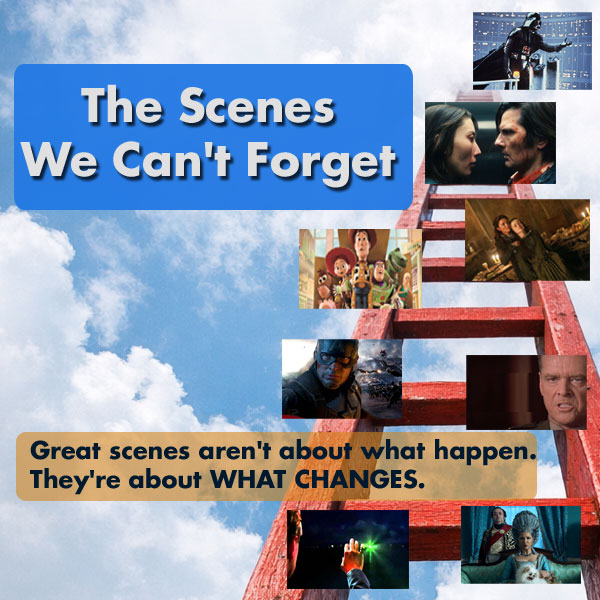
Every story you love is really just a collection of scenes you can’t forget. The diner conversation in Heat. The Red Wedding. That fireplace scene at the end of Call Me By Your Name. Gatsby reaching toward the green light. The chest-burster in Alien. “We accept the love we think we deserve” from The Perks of Being a Wallflower. These moments live in us, taking up permanent residence somewhere between our ribs. But why do THESE scenes stick while entire plots fade away?
YOUR CHALLENGE (Do This Right Now—2 Minutes):
Go. Your timer starts now. |
Done? Look at what you wrote. I bet the scene you can’t forget changed something. Changed how you saw a character, or the stakes, or what you thought the story was even about. And I bet the flat scene just moved pieces around the board without transforming anything.
That’s the secret. Great scenes aren’t about what happens—they’re about what changes.
The Hidden Architecture
Great scenes share something fundamental—something you can learn to build into your own work, whether you’re writing a novel, screenplay, or stage play.
In The Kite Runner: Hassan’s assault happens off-page while Amir watches from around the corner. Khaled Hosseini doesn’t show us the violence—he shows us Amir’s choice to do nothing. That scene works because it’s about moral cowardice, not the assault itself.
In No Country for Old Men (film): The coin flip scene in the gas station. Javier Bardem’s Anton Chigurh makes an old man bet his life on a quarter. No music. No camera tricks. Just two men and a decision. We can barely breathe.
In Hamilton: “The Room Where It Happens.” Burr finally admits what he wants—power, recognition, a seat at the table—through a showstopper that reveals character through jazz hands and jealousy.
In The Road by Cormac McCarthy: The father and son find the bunker full of food. For three pages, it’s just description of canned goods and relief. But that scene works because we’ve walked through 200 pages of starvation with them. The stakes make the stillness sing.
These couldn’t be more different in genre or medium. But they all change something fundamental. They all make a promise and break it (or keep it in an unexpected way). And they all use their medium’s unique strengths instead of fighting against them.
Why Most Scenes Just Sit There
You’ve read them. Maybe you’ve written them. Scenes that should work but somehow just… exist. Lifeless.
Two characters argue about their relationship, but nothing changes by the end. A chase scene that’s technically exciting, but we don’t care who escapes. A revelation that should shock us but lands with a thud because we don’t understand what it costs.
What’s missing isn’t more drama. It’s architecture. The hidden scaffolding that makes us unconsciously lean forward instead of checking our phone.
Medium Matters (More Than You Think)
Here’s the thing: the same emotional beat works completely differently depending on where it lives.
A character’s moment of devastating realization:
- In a novel: We’re inside their head, experiencing the thought process as it shatters
- On screen: We watch their face, the micro-expressions doing the heavy lifting
- On stage: We see the actor’s body language shift in real-time, sharing the same air
The architecture is identical. The execution? Completely different. And most writers try to force a square peg into a round hole—writing a novelistic scene in screenplay format, or a cinematic moment that can’t possibly work on the page.
Learn the Architecture
Imagine understanding what makes that coin flip scene in No Country unbearable to watch. Or what makes Hassan’s assault in The Kite Runner devastating even though we don’t see it. Or why “The Room Where It Happens” explodes off the stage.
Imagine building that same power into your own scenes—whether you’re writing a thriller that won’t let readers sleep or a screenplay that makes producers sit forward in their chairs.
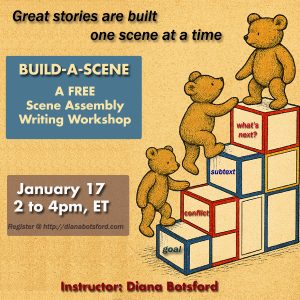 Build-A-Scene: A Free Writing Workshop
Saturday, January 17, 2026 | 2:00-5:00 PM ET | Live on Zoom
This isn’t a lecture. It’s a hands-on intensive where you’ll BUILD scenes in real-time, understand the architecture that makes them work, and walk away with tools you can use immediately.
In three hours, you’ll:
- Map out complete scenes for your current project
- Workshop scenes live with writers across different mediums
- Get worksheets and planning guides for all your remaining scenes
- Learn what changes across mediums—and what doesn’t
- Understand techniques that work whether you write prose, scripts, or stage plays
We’ll reverse-engineer scenes from novels like The Kite Runner and The Road, films like No Country for Old Men, TV like Breaking Bad, and stage productions like Hamilton—not to analyze them to death, but to steal what makes them unforgettable.
You’ll leave with:
- Mapped scenes for your project
- Scene planning worksheets you’ll use forever
- Clear understanding of your medium’s strengths
- Concrete techniques for making every scene matter
This workshop welcomes writers across all mediums—fiction, nonfiction, poetry, screenwriting, journalism, and beyond. Whether you’re a beginner or seasoned professional, you’ll discover practical tools to demolish the barriers between you and your best work.
And it’s completely free.
Space is limited to ensure quality feedback and interaction.
[Register here for the Build-A-Scene Workshop]
Final Thought
Every story is made of scenes. Every great novel, film, or play is really just a collection of unforgettable moments strung together.
The question is: Are you building scenes worth remembering? Or hoping they’ll work because you care about your story?
Hope isn’t a strategy. Architecture is.
Come build something unforgettable. See you January 17th.
The scenes you can’t forget weren’t accidents. They were built by writers who understood the architecture.