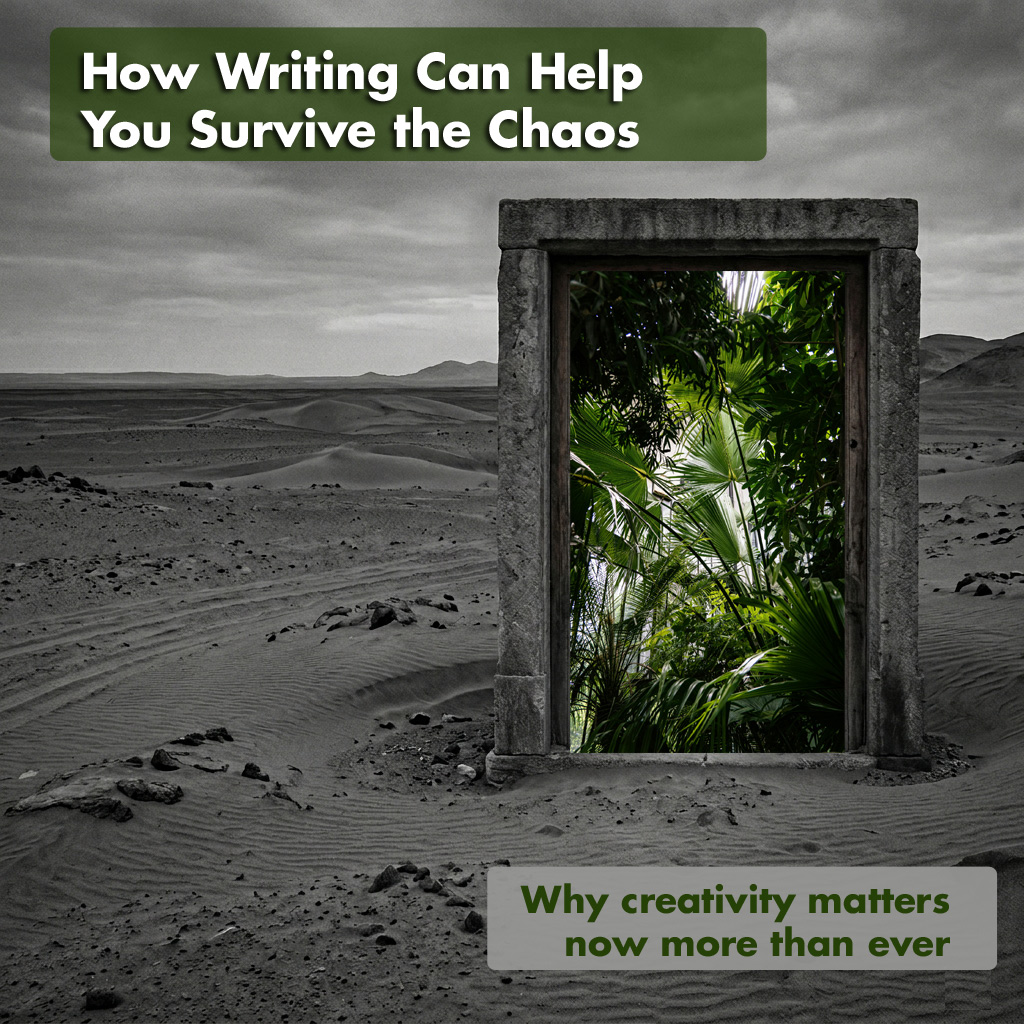
I know, I know. You’ve read half a dozen of these thought pieces just in the last month. Still, I’d like to lend my voice to the chorus and hopefully raise give you a moment’s inspiration. If nothing else, perhaps you’ll find value in your current work that in a way you didn’t consider before.
Let’s start with being honest about the moment we’re in.
The industry is fractured. The economy is unpredictable. Every time you open a news app, something new is on fire — sometimes literally. You sit down to write and some part of your brain whispers: Is this even the right time for this?
Maybe you should be doing something more practical. More urgent. More useful. Maybe no one will care. Maybe your message will get lost.
Here’s what I want to say to that voice: it’s wrong. And not in a motivational-poster, believe-in-yourself way. Wrong in a neurological, historically documented, psychologically measurable way.
Writing isn’t a luxury. It’s how humans survive chaos.
 Ready to Stop Circling and Start Rewriting?
If you've got a draft and a diagnostic full of red flags, you don't need more coffee and willpower. You need a plan, a structure, and a room full of writers doing the work alongside you.
Ready to Stop Circling and Start Rewriting?
If you've got a draft and a diagnostic full of red flags, you don't need more coffee and willpower. You need a plan, a structure, and a room full of writers doing the work alongside you.
The Screenplay & TV Pilot Rewrite Workshop runs July 11 through September 26, 2026 — twelve Saturdays, 2:00 PM ET, live on Zoom. Small group. Real feedback on your actual pages, every week. A six-phase framework that moves from structural diagnosis all the way through line-level polish.
You'll leave with a rewritten script. Not a half-finished revision. A rewritten script. Registration is now open.
What Your Brain Is Actually Doing When You Write
When the world feels out of control, the brain’s threat response goes into overdrive. The amygdala — your alarm system — starts firing at abstractions. Economic uncertainty. Political instability. The grinding low-level anxiety of not knowing what comes next.
Here’s the problem: the amygdala doesn’t distinguish well between a predator and a news cycle. It just floods the system with cortisol and says do something.
Writing gives the prefrontal cortex something to do. It redirects that anxious energy into problem-solving, pattern-making, narrative structure. You’re not escaping the world — you’re using the most sophisticated cognitive tools you have to process it.
Psychologists call this narrative sense-making. Humans are story animals. We don’t just experience events. We need to shape them into cause and effect, beginning and middle and end. When the real world resists that shape — when things feel random and unresolvable — writing fiction lets us build worlds that have the structure the real one is currently refusing to provide.
That’s not escapism. That’s the oldest coping mechanism in the species.
Exercise: Before your next writing session, spend five minutes writing about what’s making you most anxious right now. Not about your characters. About you. Don’t polish it. Don’t share it. Just get it out of the holding pattern in your head and onto the page. Then close that document and open your manuscript. Notice how much cleaner the channel feels.
The Permanence Paradox
Here’s something that helps me when the world feels like it’s dissolving.
Work persists.
Not everything. Not always. But a story someone wrote in a prison camp, in a refugee tent, in a studio apartment during a pandemic — that story exists. Someone read it. Someone will read it. The act of making something is, in a deep and literal sense, an act of resistance against the idea that nothing matters or lasts.
Writers who’ve worked through terrible periods — wars, depressions, losses — often describe the same thing: the work was an anchor. Not a distraction. An anchor. Something real they could return to, that required their full attention, that existed in a world they controlled even when the outer one was uncontrollable.
You don’t need a crisis to need an anchor. Chronic low-grade uncertainty is enough.
Exercise: Make a list of five stories — novels, films, shows, anything — that were created during or in direct response to turbulent times. Look up when they were made and what was happening in the world. Ask yourself: what would we have lost if those writers had decided it wasn’t the right time?
On the Guilt of Making Things
A lot of writers carry guilt about this. Shouldn’t I be doing something that matters? Isn’t writing self-indulgent when things are this serious?
Two things.
First: you are not the solution to every problem that exists in the world. You are one person. You cannot fix everything. What you can do is contribute what you’re actually equipped to contribute — which, in your case, is stories that illuminate human experience, create empathy, and remind people that other people have survived other impossible moments. That matters. Don’t dismiss it.
Second: the guilt is often procrastination wearing a costume. It feels virtuous. It sounds responsible. But if you examine it closely, it’s usually fear — fear that you won’t write well enough, that nobody will care, that trying means risking failure. The world’s problems are a very convenient reason not to sit down and risk the blank page.
I say this with enormous affection: don’t let the news cycle be your excuse.
Exercise: Set a timer for 20 minutes. Write without stopping, without editing, without lifting your hands from the keyboard. Don’t write anything good. Just write. When the timer goes off, count the words. Whatever that number is — you made that. It didn’t exist before you. That’s not nothing.
The Community Piece Nobody Talks About
Isolation amplifies uncertainty. This is not a theory. It’s what humans consistently report and what psychologists consistently document.
Writing is often solitary work. But the writing life doesn’t have to be. The writers who weather hard times best — creatively and psychologically — tend to be the ones who have found a community. People who understand the particular exhaustion of caring this much about something that may never be read by anyone. People who will read your pages and take them seriously. People who are also sitting down at the desk even when the world is on fire.
That community doesn’t build itself. You have to find it, or make it.
Exercise: Identify one person in your life who takes your writing seriously. Not a cheerleader — someone who pushes back, asks hard questions, wants the work to be better. If you can’t name anyone, that’s your real homework. Find your person.
The Permission You Don’t Actually Need
Nobody is going to come along and tell you the world has stabilized enough that you’re allowed to write now. That moment is not coming. There will always be something.
So here’s the thing I’d ask you to consider: what does your creative life look like in five years if you keep waiting? What does it look like if you don’t?
The time is now. It is always now. The chaos is the condition, not the obstacle.
Sit down. Open the document. Write the thing.
Every generation of writers has written through something. This one is writing through this. Keep going.