
In a television landscape obsessed with antiheroes and manufactured conflict, the return of Stargate—with the original creators at the helm—feels like coming home to the kind of storytelling we’ve been missing. This past week, I joined David Read, Darren Sumner, and Michael Shanks himself on Dial the Gate to celebrate the announcement.
Why the New Stargate Series Matters More Than Ever
So there I was, minding my own business, when the phone rang.
It was David Read. A dear friend and the incredibly charismatic host/owner of Dial the Gate, the Stargate fandom video podcast network that along with Darren Sumner’s long-spanning work with Gateworld has done more to keep this franchise alive and thriving than almost anyone else in recent years. David’s been diving deep into every aspect of the series—the creators, the actors, the writers, the fans. If it touches Stargate, David’s covered it. What Gateworld has done for print, David has done with video. The two outlets have truly been the light on the porch for this most beloved science fiction franchise, tirelessly pouring themselves into keeping fandom informed and enthused throughout the years.
And this call? David–sounding incredibly hyped up–asked me to be available on a certain day the following week because he would have something to share.
I imagined a lot of things in that time between one call and the next. None of them lived up to the big reveal.
TL;DR: Amazon Prime has greenlit the creation of a new series with Martin Gero as the showrunner and Brad Wright and Joe Mallozzi as consulting producers. The fandom—that devoted, stubborn, wonderful fandom that’s kept this franchise alive through sheer force of will—collectively lost its mind. In the best possible way.
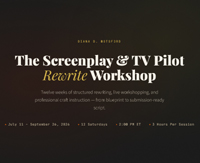 Ready to Stop Circling and Start Rewriting?
If you've got a draft and a diagnostic full of red flags, you don't need more coffee and willpower. You need a plan, a structure, and a room full of writers doing the work alongside you.
Ready to Stop Circling and Start Rewriting?
If you've got a draft and a diagnostic full of red flags, you don't need more coffee and willpower. You need a plan, a structure, and a room full of writers doing the work alongside you.
The Screenplay & TV Pilot Rewrite Workshop runs July 11 through September 26, 2026 — twelve Saturdays, 2:00 PM ET, live on Zoom. Small group. Real feedback on your actual pages, every week. A six-phase framework that moves from structural diagnosis all the way through line-level polish.
You'll leave with a rewritten script. Not a half-finished revision. A rewritten script. Registration is now open.
I’ve spent the last week on two different streaming episodes of Dial the Gate celebrating this news. First, I joined a wide spanning roundtable helmed by David and Darren on what this means for the franchise and–not to sound too redundant here–how the efforts of Gateworld and Dial the Gate have made such a significant contribution to Amazon/MGM’s decision to move forward with a new chapter.
A few days later, I had the opportunity to speak with Michael Shanks aka Dr. Daniel Jackson himself. I can’t help but admit how much I was impressed by his thoughtful and encouraging reaction.
But here’s what struck me most about the whole thing, and it wasn’t just the excitement (though there was plenty of that). Michael told us how the announcement was handled. Martin Gero sent personal emails—actual, thoughtful, personal emails—to cast and crew. Giving them a heads-up before the public announcement dropped. Letting everyone know they mattered, that everyone had been part of keeping this thing alive.
That simple gesture? That’s the Stargate ethos in action.
Why This Matters (And Why I’m Getting a Little Misty About It)
Look, I’m thrilled about this announcement. Obviously. But I’m also a little wistful, because this kind of storytelling has become almost extinct in modern television.
I’m talking about the “all for one and one for all” spirit. A team that genuinely cares about each other. That operates with a strong ethical core even when facing impossible odds. That keeps moving forward through the worst of times not despite their bond but because of it.
Stargate SG-1 and Stargate Atlantis both gave us something increasingly rare: characters who liked each other.
They trusted each other. Would walk through a literal wormhole into unknown danger because their teammates needed them. No manufactured interpersonal drama designed to keep us watching. No contrived love triangles for the sake of ratings. Just four people (and later more) who became a family through shared purpose and mutual respect.
In today’s television landscape—obsessed with antiheroes, moral ambiguity, and protagonists who spend more time fighting each other than fighting the actual problem—the Stargate approach feels genuinely revolutionary.
Give me characters who face external challenges together rather than constantly tearing each other apart from within. Give me found family over fractured relationships. Give me hope.
The Unknown and the Hopeful (Or: Let’s Write More Stargate Books!)
Right now? We don’t know what’s happening with the media tie-in rights.
But I’m hopeful. Cautiously, professionally, trying-not-to-jinx-it hopeful for a chance to return to this universe in novel form. Because here’s the thing: just in the last week alone, I’ve come up with more than twenty ideas for odd, bizarre, and utterly compelling worlds and situations an SG team could visit.
Twenty. In a week. While also teaching workshops and living my regular life.
That’s the beauty of the Stargate concept. It has infinite potential. Every planet is a new story. Every civilization becomes a mirror to examine our own humanity. Every mission asks: what does it mean to be human when faced with the infinite?
So yeah. I’m ready. The ideas are lined up like chevrons waiting to lock.
Essential SG-1: The Episodes That Built a Universe (And Broke Our Hearts)
If you’re new to the franchise—first, welcome! Second, prepare yourself emotionally—or if you’re looking to revisit the moments that made this show legendary, here’s a list of my personal favorites — episodes that I believe profoundly shaped the Stargate universe. These aren’t ranked because honestly, how do you rank your favorite children? You don’t. You just love them all for different reasons.
Paradise Lost – A masterclass in tension through Jack’s silent, drug-addled struggle to survive what an extinct race once considered paradise. Sometimes what characters don’t say matters more than dialogue.
The Gamekeeper – Explores the ethics of simulated reality and the price of comfort over truth, themes that would echo throughout the series.
The Last Stand – The evolution of Daniel and Lord Yu’s relationship, a complex dynamic I explored further in The Four Dragons and its sequel set in Antarctica, The Drift.
Cold Lazarus – An early episode that allowed us to peer inside Jack’s heart and head regarding the loss of his son—character depth that earned every emotion.
Forever in a Day – Daniel’s loss of Sha’re becomes viscerally real, transforming the stakes from abstract to devastating.
The Torment of Tantalus – The first real glimpse that the Ancients’ story would become the show’s mythology backbone.
Threads – Saying goodbye to Jacob and Selmak hits harder than almost any other loss in the series.
The Fifth Race – Jack’s absorption of the Ancient Repository leads to uncovering the vast knowledge waiting in the galaxy, a true introduction to the Asgards, and expanding the universe exponentially.
Window of Opportunity – Time loop perfection that balances comedy with emotional truth.
Lost City (Parts 1 & 2) – The culmination of seven years of mythology, raising the stakes to existential levels. The two-parter served as a kick-off to Stargate Atlantis AND to my second Stargate SG-1 novel, The Drift.
Heroes (Parts 1 & 2) – The ever timely exploration of transparency in the media and, unfortunately, the swan song for everyone’s favorite SG CMO. The inspiration for Perceptions, my IAMTW Scribe Award-nominated short story about the team working through grief after Janet’s death. You can read the story in the first volume of the Stargate short story Far Horizon anthologies.
Pretense – Courtroom drama meets alien culture, showcasing the show’s ability to blend genres seamlessly. More importantly, we happily say goodbye to Klorel and welcome back to Skaara.
Absolute Power – What would Daniel do with unlimited power? The answer is both uncomfortable and revealing.
2010 – Brad Wright’s masterful exploration of time travel consequences; his approach has significantly influenced my own temporal mechanics as seen in Epilogue the Series.
Serpent’s Song – Is celebrating the death of your enemy a good thing or ??? This episode explores moral complexity at its finest while giving us a glimpse at the origins of Apophis’ host body before being taken by the Goa’uld.
Abyss – Jack’s torture and repeated death creates one of the series’ darkest, most affecting hours.
Beyond SG-1: Because the Other Series Deserve Love Too
Let’s not forget… Stargate Atlantis brought us The Shrine —McKay’s heartbreaking cognitive decline was so deftly handled that I was compelled to nominate the script the Nebula awards. Sunday—proof that sudden loss mirrors real life’s randomness in the worst possible way. And Vegas—an alternate universe noir that showed just how format-flexible this franchise could be when it wanted to play.
Stargate Universe got darker, grittier, and honestly? That second season was kinda brilliant. I still maintain that Brad Wright absolutely intended to have the Destiny crew become slung through some great cosmic accident back to the beginning of time in which they cause the Big Bang. Sadly, we’ll never know… Or will we?
What Comes Next (And Why I’m Refusing to Be Cynical About It)
Amazon Prime backing the original creators. Check.
A franchise that respects its past while moving boldly forward. Check.
A fanbase that kept the gate open through sheer determination and stubborn love. Check.
Michael Shanks talked about threading a needle—hitting every beat while traveling at impossible speed, navigating all these competing interests and expectations. And somehow, against all odds, they’re doing it right. They’re honoring what mattered. They’re including the people who kept this thing alive.
This isn’t just nostalgia. Though sure, there’s some of that, and I won’t apologize for it.
This is proof that stories about people who care about each other, who face the universe together, who maintain their ethics under pressure—these stories still matter. Maybe now more than ever, when the world feels like it’s constantly pulling us apart, we need stories that show us how to pull together.
The gate is opening again.
And those of us who never stopped believing? We’re ready to step through.