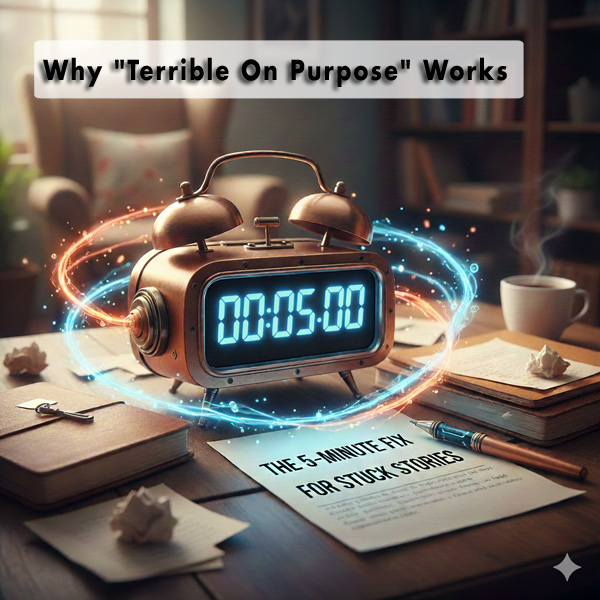
When your brain gets in the way of your story, that’s okay. Learn to embrace the awful first draft.
DO THIS RIGHT NOW:
YOUR CHALLENGE (5 Minutes):Your story is stuck. You know exactly where. Set a timer for 5 minutes and write the WORST possible way this scene could continue. Go full soap opera. Melodrama. Ridiculous coincidence. Someone’s evil twin. An asteroid. A surprise pregnancy. A dragon (even if you’re writing contemporary realism). Dialogue so purple it makes your eyes hurt. Go. Your timer starts now. |

Done?
Welcome back. How did that feel? Terrible? Good. That’s the point.
Here’s what just happened: You bypassed your inner critic by giving yourself permission to write badly. That perfectionist voice that’s been holding you hostage? It just got benched because you weren’t trying to write well—you were trying to write terribly. And in doing so, you probably discovered something interesting buried in all that absurdity.
This is the secret professional writers know but rarely talk about: Bad writing is the express lane to good writing.
Why “Terrible On Purpose” Works
Your brain has two modes: creator and editor. The problem is, most writers try to run both simultaneously, which is like trying to drive with one foot on the gas and one on the brake. You lurch forward, jerk to a stop, go nowhere fast, and end up with transmission damage.
When you commit to writing badly, you shut down the editor completely. The creator can finally run wild. And here’s the beautiful irony: once you stop trying so hard to be good, you often stumble into something genuinely interesting.
Think about it. That ridiculous soap opera scene you just wrote? Somewhere in there, buried under the melodrama, might be:
- A character motivation you hadn’t considered
- An unexpected emotional truth
- A plot twist that actually works (minus the evil twin)
- A piece of dialogue that reveals something real
The Three-Draft Speed Fix
Now let’s make this technique even more powerful. You’ve already done Draft One (The Terrible Version). Here’s how to turn that hot mess into something usable:
Draft Two: The Emotional Core (3 minutes)
Reread your terrible version. Ask yourself: What emotion was I actually going for here? Strip away all the melodrama and find the feeling underneath. Now rewrite the scene focusing only on that emotion. No evil twins. No asteroids. Just the raw feeling.
Whether you’re writing a screenplay or a novel, this works the same way. In a script, this might be the moment where your character physically reacts before speaking. In prose, this might be the internal thought that precedes the action.
Draft Three: The Controlled Version (5 minutes)
Take the emotional truth you found in Draft Two and now add back the structure. The plot logic. The character consistency. The medium-appropriate format (scene description for screenwriters, narrative flow for novelists).
But here’s the key: You’re not starting from scratch this time. You’re building on the emotional truth you excavated from the terrible version. That’s your foundation.
Real Writer Example
Let me show you how this actually works:
Terrible Version: Sarah gasped as she opened the door. “Mother! But you died in the fire! And who’s that behind you? My long-lost twin sister? And is that… is that a CONTRACT TO SELL THE FAMILY MANSION TO EVIL DEVELOPERS?!”
Emotional Core: The person Sarah least wants to see appears at the worst possible moment.
Controlled Version (Novel): The knock came while Sarah was still in yesterday’s clothes, the apartment a crime scene of unpacked boxes. Of course it did. She opened the door and her mother looked her up and down with that familiar expression—the one that could reduce grown women to teenagers failing an inspection.
Controlled Version (Screenplay):
INT. SARAH'S APARTMENT - DAY

Unpacked boxes everywhere. Sarah, wearing yesterday's clothes,
freezes mid-step as someone KNOCKS.

She opens the door. Her mother DIANE (60s, impeccably dressed)
takes in the chaos with one sweeping glance.

                    DIANE
          I should have called.

                    SARAH
          Would you have?

A moment. Diane's jaw tightens.
See the difference? The terrible version led us to the emotional truth (unwanted appearance at vulnerable moment), which then generated two genuine scenes—one for prose, one for script—that actually work.
 When You’re Stuck, Get Worse
The next time you find yourself staring at a stuck scene—whether it’s a chapter in your novel or a screenplay scene that won’t resolve—try this exercise:
- Go terrible (5 minutes): Write the worst, most over-the-top version possible
- Find the feeling (3 minutes): What emotion or truth is buried in the chaos?
- Build the real thing (5-7 minutes): Let that truth guide you to the actual scene
Total time investment: 15 minutes maximum.
Fifteen minutes that could unstick weeks of paralysis.
The Permission Principle
Here’s the uncomfortable truth about writer’s block: Most of the time, we’re not actually stuck. We’re scared. Scared of writing badly. Scared of wasting time. Scared that if we write the wrong thing, we’ll never find the right thing.
But writing the wrong thing is exactly how you discover the right thing.
Every professional writer has a garbage pile. First drafts that would make English teachers weep. Scenes that went nowhere. Characters who face-planted. Dialogue that died on the page. The difference between professional writers and blocked writers isn’t talent—it’s permission.
Permission to suck. Permission to experiment. Permission to throw away what doesn’t work. Permission to write badly on the way to writing well.
Your Emergency Toolkit
When your story stalls (and it will, because everyone’s does), you now have a reliable tool:
For screenplay writers: Write the scene as if you’re pitching it to someone who loves trashy TV. Go full Days of Our Lives. Then find the kernel of truth underneath and rebuild using proper screenplay format.
For novelists: Write the scene as if you’re telling it to a friend who loves gossip and drama. Over-explain everything. Use every cliché. Make it absolutely purple. Then strip it down to the emotional truth and rebuild with your actual prose style.
For everyone: Remember that bad writing isn’t failure—it’s a necessary step in the process. It’s warmup. It’s excavation. It’s how you trick your brain into getting out of its own way.
 The Workshop That Teaches This (And More)
This “terrible on purpose” technique is just one tool in a much bigger toolkit for breaking through creative paralysis. If you found this exercise helpful, imagine spending three hours learning and practicing multiple breakthrough techniques—all designed to demolish the specific blocks that keep YOU from writing.
Writer’s Block Busters: A 3-Hour Intensive
Saturday, February 7, 2026 | 2:00-5:00 PM ET | Live on Zoom
This workshop isn’t about theory. It’s about action. You’ll complete 8-10 timed writing exercises, learn rapid-generation techniques, meet your inner critic and then mock it mercilessly, and walk away with a personalized emergency kit of strategies that actually work for your brain.
Whether you write novels, short stories, screenplays, poetry, creative nonfiction, or anything else with words, this workshop gives you practical tools to use the moment you sit down and nothing comes out.
Space is limited to ensure everyone gets attention and support. Sign up now for early bird pricing.
Final Thought
The next time someone tells you “just sit down and write,” you can now truthfully say you did—you wrote the worst scene possible, found the truth hidden inside it, and built something real from the wreckage.
That’s not just writing. That’s alchemy.
Now go set that timer again. You have more terrible scenes to write. And somewhere in that mess, your story is waiting to break free.
Remember: Every great scene started as a bad idea that someone was brave enough to write down anyway.