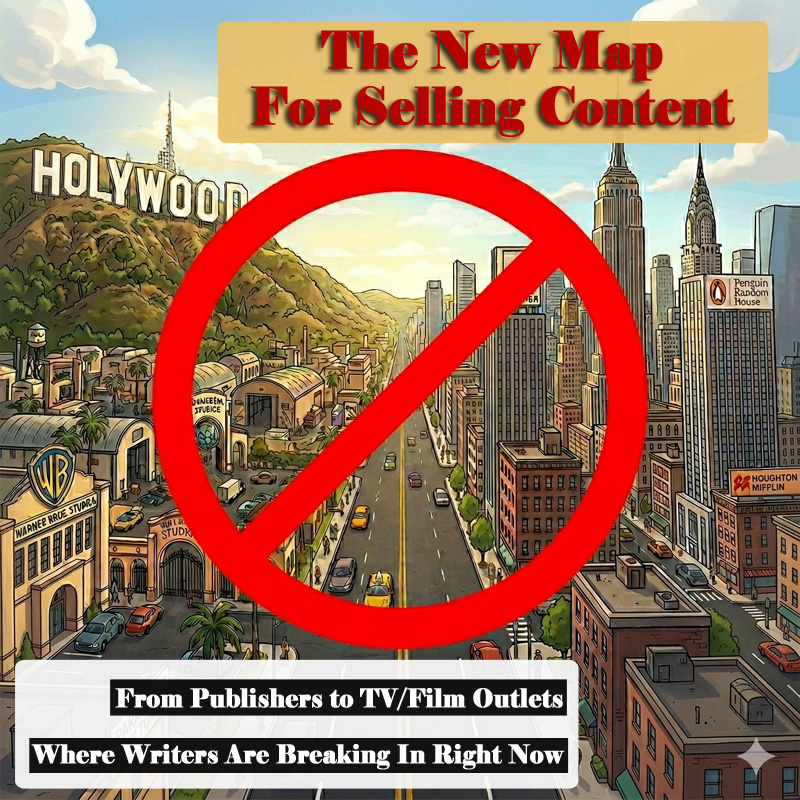
The old roads still exist. Query agents. Submit to publishers. Pitch the studios. Wait. And wait. And wait.
But while you’re waiting, a lot of writers stopped waiting — and built something instead. The market has split into two distinct territories, and the smart move is to understand both.
Here’s a fast tour of where the doors are actually open.
The Traditional Route (Still Worth It. Sort Of.)
Yes, the Big Five publishers and the major studios are more consolidated than ever. Yes, the gatekeepers are real. But traditional publishing and Hollywood still offer things the indie world can’t: distribution at scale, advance money, and the kind of legitimacy that opens certain doors permanently.
For prose writers:
The traditional path runs through a literary agent. No agent, no Big Five publisher — that’s just how it works. Query letters, sample pages, a polished manuscript. The process is slow and the odds are genuinely long. But for certain genres — particularly literary fiction, upmarket commercial fiction, and narrative nonfiction — traditional publishing still represents the gold standard.
 Ready to Stop Circling and Start Rewriting?
If you've got a draft and a diagnostic full of red flags, you don't need more coffee and willpower. You need a plan, a structure, and a room full of writers doing the work alongside you.
Ready to Stop Circling and Start Rewriting?
If you've got a draft and a diagnostic full of red flags, you don't need more coffee and willpower. You need a plan, a structure, and a room full of writers doing the work alongside you.
The Screenplay & TV Pilot Rewrite Workshop runs July 11 through September 26, 2026 — twelve Saturdays, 2:00 PM ET, live on Zoom. Small group. Real feedback on your actual pages, every week. A six-phase framework that moves from structural diagnosis all the way through line-level polish.
You'll leave with a rewritten script. Not a half-finished revision. A rewritten script. Registration is now open.
For screenwriters:
The path runs through competitions, coverage, and representation. Win or place well in the right competition (Nicholl, Austin Film Festival, Final Draft Big Break), get your script in front of readers, attract a manager or agent. That’s the pipeline. It’s slow. It’s real.
The honest truth about traditional routes: They reward patience and a high tolerance for rejection. If you have both, they’re still worth pursuing.
The Indie Route (Faster, Harder, Yours)
This is where things get interesting.
YouTube
YouTube now captures more U.S. TV viewing than any single streaming platform. That’s not a typo. It’s become the most-watched streaming service in America — and it’s wide open to creators who show up consistently with content that earns an audience.
For screenwriters and filmmakers: short films, micro-series, proof-of-concept episodes. A strong short on YouTube has launched careers. It shows producers you can actually make something, not just write it.
For prose writers and playwrights: author channels, craft content, serialized readings. Not glamorous. Deeply effective for building a community that follows you to whatever you release next.
Substack
Serial fiction on Substack has become a legitimate income source for writers who understand that readers will pay for a relationship, not just a story. Publish chapters on a consistent schedule, build your list, convert free readers to paid subscribers. Genres that do especially well: romance, horror, sci-fi, and thriller.
You own your list. That’s the whole point.
Wattpad
90 million monthly readers. The audience is young, voracious, and genuinely passionate about serialized storytelling. Careers have launched here — including writers who went on to traditional publishing deals because of their Wattpad following. Think of it as a long audition with readers, not gatekeepers.
Crowdfunding
Kickstarter and Seed & Spark have funded short films, documentary projects, anthologies, and indie novels. This isn’t begging — it’s proof of concept. A successful crowdfunding campaign tells every future investor and publisher that your audience is real and already paying attention.
Podcasts and Audio Drama
Underutilized and wide open. Audio drama has a dedicated, growing listenership, low production costs relative to film, and almost no barrier to entry for writers who know how to write for the ear. Several audio dramas have been optioned for film and television after building substantial podcast audiences.
The Format You Might Be Ignoring: Vertical Storytelling
This one is changing faster than almost anything else in the industry.
Vertical video — the tall, phone-native format of TikTok, Instagram Reels, and YouTube Shorts — is developing its own storytelling grammar. Quick cuts. Immediate hooks. Stories built for the swipe.
Writers who understand this format are creating serialized micro-narratives: stories told in 60-to-90-second vertical episodes with genuine cliffhangers, character continuity, and world-building. Some are going viral. Some are attracting production interest. All of them are building audiences faster than any other format currently available.
If you write screenplays, this is worth your time to study. The structural demands are different — every second costs you — but the skills transfer directly from what you already know.
The Real Competitive Advantage Right Now
Whether you go traditional, indie, or both — the writers breaking through share one thing: an audience they built themselves before they needed it.
An email list. A YouTube channel. A Substack following. A social media presence that’s actually about the work. This doesn’t replace craft. It amplifies it.
The map has changed. The territory is bigger than it’s ever been.
Pick a road and move.
Want to talk through where your project fits in this landscape? Contact me and we’ll figure out where together.